
Summary: In the AI Era, what is the most precious thing?


ETC momentum shows RSI neutral at 44.77 with MACD positive histogram giving mixed signals, price below EMA20 carrying bearish short-term pressure. Lack of volume confirmation limits trend strength ...


Congress is advancing developer protections as BRCA and other crypto bills reshape U.S policy.


Bitcoin has reclaimed the $66,000 level and is now attempting to consolidate above it in order to extend its recovery. The move has improved short-term momentum, but structural signals suggest that upside conviction remains fragile. Holding above $66K is technically important, yet the broader supply backdrop may limit the sustainability of further gains. Related Reading: Engine Stalled: How The $8 Billion ‘October Shock’ Left Bitcoin’s Spot Market In A Liquidity Trap According to analyst Axel Adler, cumulative exchange netflows remain a critical constraint. As long as netflows stay positive — meaning more Bitcoin is moving onto exchanges than leaving them — the probability of sustained price expansion remains limited. Recent data from the Bitcoin Exchange Reserve (All Exchanges, Daily) metric reinforces this caution. Since January 14, total BTC held across major exchanges has increased from 2.723 million to 2.752 million BTC, representing a net addition of roughly 28,489 BTC, or about 1% over 45 days. Although the trajectory has not been linear — with a local peak near 2.794 million BTC in early February followed by a partial pullback — reserves have consistently re-established themselves near the upper bound of the range. This stepwise growth structure signals a persistent return of coins to exchanges. Historically, rising exchange balances imply expanding potential sell-side supply. Until reserves break decisively below January’s 2.723 million BTC baseline, structural selling pressure remains embedded in the market. Netflow Regime Shift Signals Structural Distribution The 30-day moving average of Bitcoin exchange netflows provides critical confirmation that the recent reserve growth is not incidental. The transition from -1,187 BTC on January 14 to +628 BTC by February 27 represents more than a short-term fluctuation — it reflects a structural regime shift from accumulation to distribution. When the SMA(30) netflow remains negative, it indicates coins are being withdrawn from exchanges faster than they are deposited, typically associated with accumulation behavior. The steady climb toward zero throughout January, followed by a decisive cross into positive territory on February 1, marks a clear behavioral pivot. The fact that the indicator has held above zero for nearly four consecutive weeks significantly reduces the probability of a false breakout. The mid-February impulse toward +1,069 BTC highlights the intensity of inflows during peak distribution pressure. Although the metric moderated afterward, it did not revert below zero, suggesting that coins continue to migrate toward exchanges at a sustained pace. At an average structural inflow rate of roughly 628 BTC per day, the supply available for potential sale is expanding. Until the SMA(30) decisively flips back into negative territory, exchange-side pressure remains dominant, limiting the probability of a durable bullish regime reestablishing itself. Related Reading: The $2,000 Fault Line: Why Ethereum’s Record Volatility Signals An Imminent Explosion Bitcoin Tests Macro Support After Rejection From Highs Bitcoin’s weekly structure reflects a clear transition from expansion to correction following rejection near the $120K–$130K region. The chart shows a decisive breakdown below the $90K–$95K zone, which previously acted as structural support. That level has now flipped into resistance, confirming a shift in market control. Price is currently consolidating near $66K after a sharp decline, hovering just above the 200-week moving average. This level historically acts as a macro support during deeper corrective phases. Holding above it is technically significant; sustained closes below would likely signal a more prolonged bear cycle. The 50-week moving average has rolled over and is trending downward, while the 100-week average is flattening. This alignment indicates weakening intermediate momentum and suggests rallies may face overhead pressure unless key trend levels are reclaimed. Related Reading: Digital Gold Is Dead: The Institutional Architecture Binding Bitcoin To The Nasdaq In The 2026 Downturn Volume expanded notably during the breakdown phase, pointing to forced liquidations and distribution rather than orderly consolidation. Since then, participation has moderated, implying that panic selling has eased but conviction remains limited. Structurally, Bitcoin sits at a pivotal inflection point. A reclaim of the mid-$80K region would be required to restore bullish structure. Conversely, failure to defend current support could expose deeper liquidity zones below. Featured image from ChatGPT, chart from TradingView.com


Shiba Inu exchanges seeing substantial growth in market activity, with half a trillion tokens flowing in.


Ethereum is navigating a period of heightened volatility and uncertainty as it hovers around the critical $2,000 threshold. While recent price action suggests temporary stabilization after weeks of selling pressure, conviction remains limited. The $2,000 level is functioning less as confirmed support and more as a psychological battleground where short-term positioning, liquidity conditions, and sentiment are colliding. A recent analysis from Arab Chain offers additional structural insight through the ETH Binance Liquid vs. Illiquid Supply Model. This framework separates Ethereum held on Binance into liquid supply — coins readily available for trading — and illiquid supply, which is comparatively less likely to move in the short term. As of February, Binance’s total ETH reserves stand at approximately 3.57 million ETH. Of this amount, around 1.16 million ETH is classified as liquid supply, while 2.40 million ETH is categorized as illiquid. This distribution matters. A relatively smaller liquid component can limit immediate sell-side pressure, but it does not eliminate risk if sentiment deteriorates. Conversely, a larger illiquid base may reflect longer holding behavior or strategic positioning rather than imminent distribution. At a moment when price hovers near a key technical pivot, the composition of exchange reserves becomes a meaningful variable in assessing Ethereum’s next structural move. Liquid vs. Illiquid Supply Signals A Fragile Equilibrium The current reserve composition on Binance suggests Ethereum is operating within a structurally balanced environment rather than an immediate distribution phase. With illiquid supply accounting for the majority of the 3.57 million ETH held on the platform, a substantial portion of coins appears relatively dormant. Illiquid balances are typically associated with longer holding horizons or reduced trading frequency, which tends to dampen immediate sell-side pressure. This matters at a time when ETH is hovering near $2,000. A dominant illiquid share implies that most holders are not actively positioning for a rapid exit. In previous cycles, sharp increases in liquid supply often preceded volatility spikes, as coins became readily available for market execution. That dynamic is not yet evident at scale. By contrast, liquid supply historically expands during speculative phases, when traders rotate capital aggressively or prepare for directional exposure. The absence of a pronounced expansion suggests that, for now, speculative intensity remains contained. The relatively stable gap between liquid and illiquid supply indicates equilibrium between holding behavior and active trading. However, this balance is conditional. A meaningful shift toward higher liquid supply would increase the probability of renewed volatility. Conversely, sustained illiquid dominance could help absorb price shocks and moderate downside acceleration. Ethereum Tests Long-Term Support As Downtrend Accelerates Ethereum remains under structural pressure as price hovers near the $2,000 region following a sharp breakdown from the $3,200–$3,400 zone. The weekly chart shows a clear loss of bullish structure, with lower highs forming since the late-2025 peak and momentum decisively shifting to the downside. Price is now trading below the 50-week and 100-week moving averages, both of which are beginning to flatten or slope downward. This configuration typically signals weakening intermediate momentum and a transition into a corrective phase. Notably, Ethereum briefly tested levels near $1,800 before bouncing, suggesting the presence of reactive demand in that liquidity pocket. However, the recovery remains limited and has not yet reclaimed key moving averages. The 200-week moving average, positioned lower on the chart, remains upward sloping, indicating that the broader macro trend has not fully reversed. Historically, this level has served as strong structural support during deeper cycle corrections. If downside pressure resumes, this zone could become a critical area to monitor. Volume expanded significantly during the recent selloff, reflecting forced positioning adjustments rather than gradual distribution. Since then, activity has moderated, pointing to temporary stabilization. Featured image from ChatGPT, chart from TradingView.com


BlockBeats News, February 28th, OpenAI Founder Sam Altman announced a partnership agreement with the US Department of Defense: deploying its AI models in a classified network. Throughout all interactions, the Department of Defense has demonstrated a high level of commitment to security and eagerness to collaborate with OpenAI for the best outcomes.The security and broad beneficial alignment of artificial intelligence are at the core of our mission. OpenAI's two most important security principles are: prohibiting mass surveillance in the United States and holding people responsible for the use of force, including the use of autonomous weapon systems. The Department of Defense acknowledges these principles, which are reflected in law and policy, and we have also included them in the agreement.OpenAI will also build technical safeguards to ensure the model runs smoothly, as desired by the Department of Defense. Functional Enhancement Devices (FEDs) will be deployed to assist model operations, and to ensure the model's security, it will only be deployed on a cloud network. The Department of Defense has requested that all AI companies be offered the same terms, and all companies should be willing to accept these terms. OpenAI strongly hopes the situation can be de-escalated, avoiding recourse to legal and governmental action, and reaching reasonable agreements. We will continue to do our best to serve all of humanity. The world is a complex, messy, and sometimes even dangerous place.

AAVE is being tested at critical support levels at 112.80 dollars; RSI at 40 shows weak momentum, while MACD gives a mildly bullish signal. Bitcoin's downtrend is increasing pressure on altcoins; m...

Morgan Stanley applied to the OCC for a national trust bank for digital asset custody. BTC testing support at 65.924$; institutional expansion is accelerating. Details and technical analysis here. ...

The CLARITY Act’s stablecoin yield debate stalls US digital asset regulation in the Senate. Banks want strict limits, while crypto advocates warn against stifling innovation. Continue Reading: Senate Deadlock Stalls US Crypto Regulation Over Stablecoin Yields The post Senate Deadlock Stalls US Crypto Regulation Over Stablecoin Yields appeared first on COINTURK NEWS .


Wu Jihan is waiting for AI's money to catch up with the speed of debt.

BlockBeats News, February 28th, according to Fortune report, OpenAI founder Sam Altman said that OpenAI is in talks with the US Department of Defense for a potential agreement to use its AI models and tools, although no contract has been signed yet. OpenAI will retain control over how the technology is secured, where the models are deployed, and in which regions, with deployment limited to cloud environments rather than "on the edge" systems. In a military context, edge systems could include aircraft and drones.As a significant concession, the US government has agreed to incorporate OpenAI's set "red lines" into the contract terms, including a prohibition on using AI for autonomous weapon systems, domestic mass surveillance, and critical decision-making processes.Earlier today, Anthropic rejected the Pentagon's open security clearance request, prompting a ban by Trump.

NEAR volume declined to 165.68 million dollars, remaining low during pullbacks and limiting selling pressure. While this provides accumulation signals, BTC correlation requires caution.
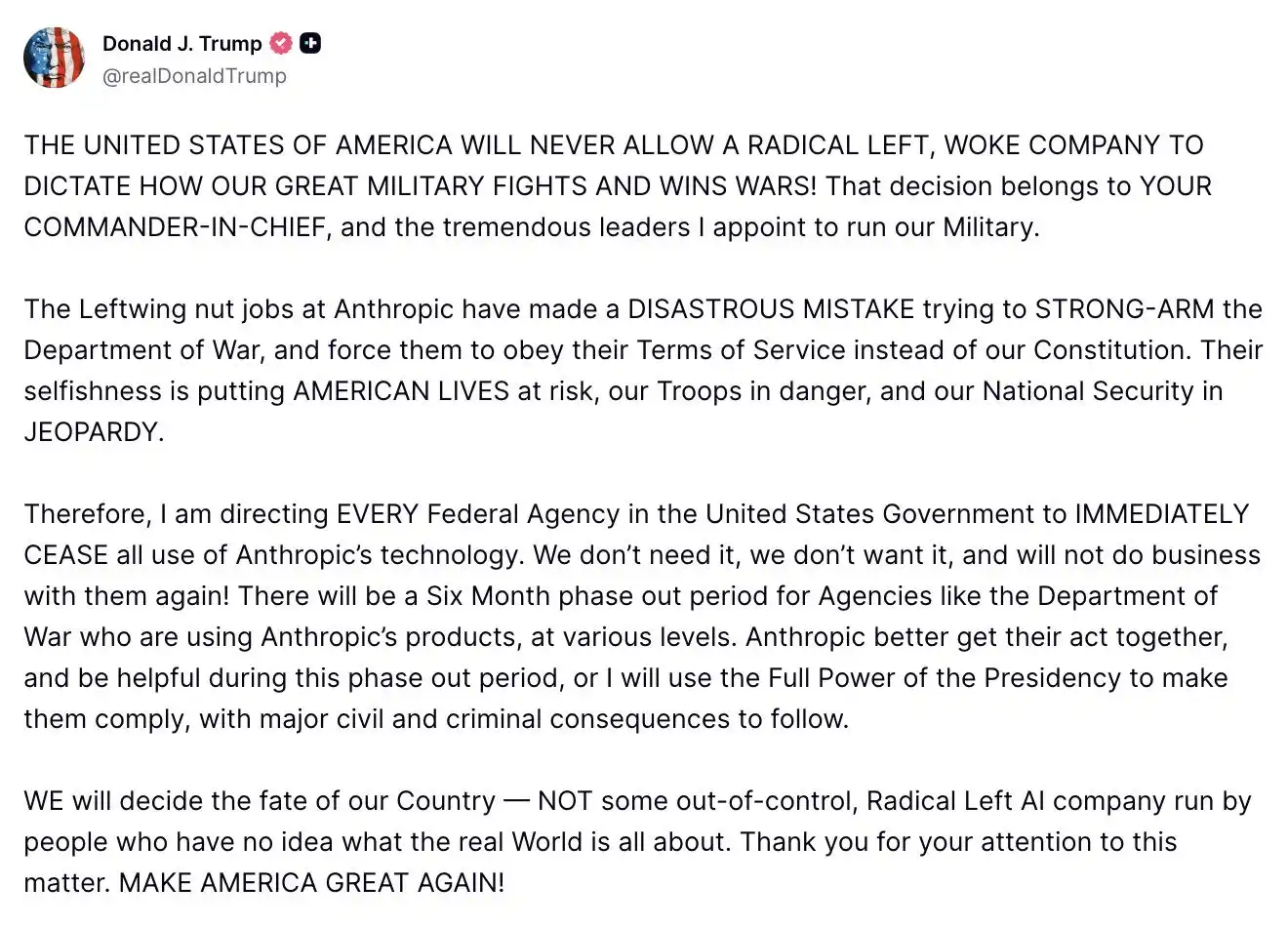
BlockBeats News, February 28: The Pentagon has asked Anthropic to remove the security restrictions on "autonomous killer robots" and "mass surveillance" built into Claude. Otherwise, they will lose a $200 million contract and be labeled a supply chain risk. Anthropic refused to make a written commitment, with co-founder and CEO Dario Amodei responding firmly, "These threats cannot change our position. We cannot in good conscience comply with their request."OpenAI CEO Sam Altman also voiced support for Anthropic on CNBC, stating, "I don't think the Pentagon should make this kind of threat. Despite many disagreements I have with Anthropic, they are trustworthy in the security field." The AI field's two fiercest competitors have just drawn this red line in public, and at last week's India AI Summit, Sam Altman and Dario Amodei even refused to shake hands in a group photo. Meanwhile, 70 OpenAI employees have signed an open letter titled "We Will Not Divide," and Google engineers have also come out in support.Trump responded strongly: I have instructed every federal agency of the U.S. government to immediately stop using Anthropic's technology. We don't need it, we don't want it, and we won't do business with them again! Agencies like the Department of War that use Anthropic products will have a six-month phased elimination period. Anthropic had better perform well during this phase-out period, provide assistance, or I will use the full power of the presidency to compel compliance, and they will face significant civil and criminal consequences.

The Wall Street banking giant has been accelerating its foray into crypto, filing to launch Bitcoin, Ether and Solana ETFs in January.


Ripple’s chief legal officer is challenging claims that cryptocurrency lacks real-world utility, pointing to rising U.S. merchant adoption and growing consumer reliance as evidence that digital assets are becoming embedded in everyday commerce. Ripple’s Legal Chief Challenges Media Narrative on Crypto Utility Ripple Chief Legal Officer Stuart Alderoty, who also serves as President of the

ICP investors welcomed some good news this week.

Ripple is reshaping how builders on the XRP Ledger get funded in 2026, arguing that the ecosystem has reached a point where support needs to flow through more than Ripple-linked programs alone. The change matters because it signals a deliberate move away from a relatively centralized funding structure toward a broader network of DAOs, independent hubs, universities and venture partners. In its latest ecosystem update , Ripple said more than $550 million has already been deployed into XRPL initiatives since 2017, spanning non-equity grants, builder incentives, strategic partnerships and growth programs. Since 2021, those efforts have included hackathons, builder bounties, XRPL Grants and the XRPL Accelerator, with nearly 200 projects supported across areas including payments, DeFi, tokenization, AI, gaming, e-commerce and enterprise finance. XRP Ledger Enters New Phase The core message is that 2026 marks a structural pivot. Ripple said ecosystem funding has historically flowed through Ripple-supported channels, but that the next phase will lean on a “more distributed model” in which independent organizations, regional hubs, venture firms and community-led initiatives take on a larger role. The company framed the objective as giving builders “multiple channels” to access capital and support, rather than relying on a single gatekeeper. At the center of that shift is a new FinTech Builder Program aimed at startups building institutional-grade financial applications on XRPL. Ripple said the program will focus on use cases including stablecoin payments , credit infrastructure, tokenization and regulated financial services, while offering more than a traditional grants track. According to the post, founders will get support “across the entire development lifecycle,” from product design through market launch, with help on XRPL integration, strategy and partnerships. Ripple also outlined a wider support stack around that program. That includes expanded accelerator partnerships with venture firms and startup platforms, regional startup competitions, and builder awards meant to help projects after hackathons or competitions, when early traction still needs a bridge to something durable. The emphasis throughout is less on one-off experimentation and more on getting teams to production-ready financial products. The more interesting signal, though, may be where decision-making starts to move. Ripple highlighted XAO DAO as a hybrid DAO built for XRPL that will fund developers, community builders and early-stage ideas through microgrants. It said the DAO is designed to “amplify community voice” and create feedback loops where members submit proposals, vote on priorities and help steer the ecosystem’s direction. In parallel, XRPL Commons is positioned as an independent pillar of support, with Ripple explicitly saying the aim is to ensure that “no single organization becomes the sole gatekeeper” for ecosystem funding. Other pieces of the 2026 map point to geographic and institutional expansion. Ripple said XRP Asia is being developed as a dedicated APAC hub with a long-term plan for localized funding and regional ecosystem growth. UDAX, first launched with UC Berkeley in fall 2025, is set to expand this year to Fundação Getulio Vargas in São Paulo, Oxford in the summer, and Berkeley again in the fall. Ripple also pointed to growing venture participation from firms including Dragonfly, Pantera, Franklin Templeton and Tenity as another sign that XRPL is trying to mature from grant-backed experimentation into a venue for fundable, production-scale startups. At press time, XRP traded at $1.3773.

The latest Jane Street debate on X is meeting a blunt rebuttal from Ari Paul. The BlockTower founder, who says he used to work as a Wall Street market maker 15 years ago, argues that Bitcoin’s failure to push higher is better explained by spot sell-side than by a long-running suppression campaign. Paul’s answer was direct. “In short: no,” he wrote, before adding that market makers do “game the system” in many ways, but that in liquid products such as BTC ETFs, the effect is usually limited to “meaningful but small costs to consumers,” not a lasting distortion of the underlying asset price. He framed the distinction as one between short-term microstructure games and a broader claim that one firm kept Bitcoin from reaching far higher levels. Bitcoin Manipulation? Small Moves, Fast Reversions To make that case, Paul pointed to the kind of behavior traders on desks know well. “For example, market makers may manipulate the price to run stop limit orders,” he wrote. “But that’s typically on an intraday timeframe. So they might run an asset like MSFT or BTC 2% in a weak market to trigger stops, then a few seconds or minutes later, the price is mostly back to where it was before.” In his telling, that is still manipulation, but it is not the same as structurally pinning Bitcoin below some imagined fair value for months. Related Reading: Bitcoin Spot Volumes Sink To 2024 Lows As Coinbase Selling Pressure Eases That argument lands against a more conspiratorial narrative now circulating online, why Bitcoin is not already at $150,000. Paul’s pushback does not deny that large Wall Street firms can shape short-term trading conditions. It rejects the stronger claim that such activity is the central explanation for Bitcoin’s broader price path. Paul’s core point was much less dramatic. “Why is BTC down? Because OGs sold tens of thousands of coins, and not enough people wanted to buy them.” That line closely matched the view from renowned on-chain analyst James Check, who argued that “Jane Street didn’t suppress the Bitcoin price” and that “HODLers all did,” by selling large amounts of spot into the market. Jane Street didn’t suppress the Bitcoin price folks. HODLers all did. It’s just not that hard, stop summoning your inner salty goldbug but blaming manipulators. People. Sold. A. Fucktonne. Of. Spot. Bitcoin. https://t.co/CrWgPUzUFP pic.twitter.com/N3VhgYjKhm — _Checkmate 🟠🔑⚡☢️🛢️ (@_Checkmatey_) February 26, 2026 He added: “My point has always been the same; manipulation is a thing that has always, will always, and is indeed the literal job of large wall street firms. However, you do not need that as the central argument to explain why the price didn’t go higher, nor why it went lower. That can be well and truly explained by looking at spot sell-side.” Paul did leave room for exceptions. He wrote that there are rare cases where Wall Street manipulates an asset in major ways over a longer period, but said those cases are uncommon because they are risky and harder to profit from than people assume. Related Reading: Is Jane Street Why Bitcoin Isn’t At $150K? Expert Debunks The Myth “There are rare exceptions where Wall Street manipulates an asset in major ways longer term, but this is quite rare because it’s very risky and not as easy as it looks to profit. 99% of the time that an asset isn’t moving like you want and people are crying “manipulation”, it’s best to embrace the cognitive dissonance, avoid the “easy way out” of blaming manipulation,” Paul wrote. That leaves the current Jane Street argument in a narrower frame. Yes, large firms can influence intraday flows, liquidity, and execution quality. But based on Paul’s account, that is a long way from proving that one market maker is the reason Bitcoin is not trading materially higher. Notably, the Jane Street theory picked up fresh attention after Terraform Labs’ wind-down administrator sued the firm in Manhattan federal court, alleging insider trading tied to Terra’s 2022 collapse. The complaint says Jane Street used a private chat called “Bryce’s Secret” to obtain non-public information and alleges an 85 million UST trade on Curve that helped trigger a selloff; Jane Street has denied wrongdoing and called the case opportunistic. At press time, BTC traded at $66,090. Featured image created with DALL.E, chart from TradingView.com

This is more like a manifesto, discussing "the very reason we are here."


 京公网安备 11010802028427号